Arriving at Madrid-Barajas Airport: Terminals and Ways into the City
What to expect when you land at Madrid-Barajas, how each way into the city compares, and when a pre-booked transfer is worth it.
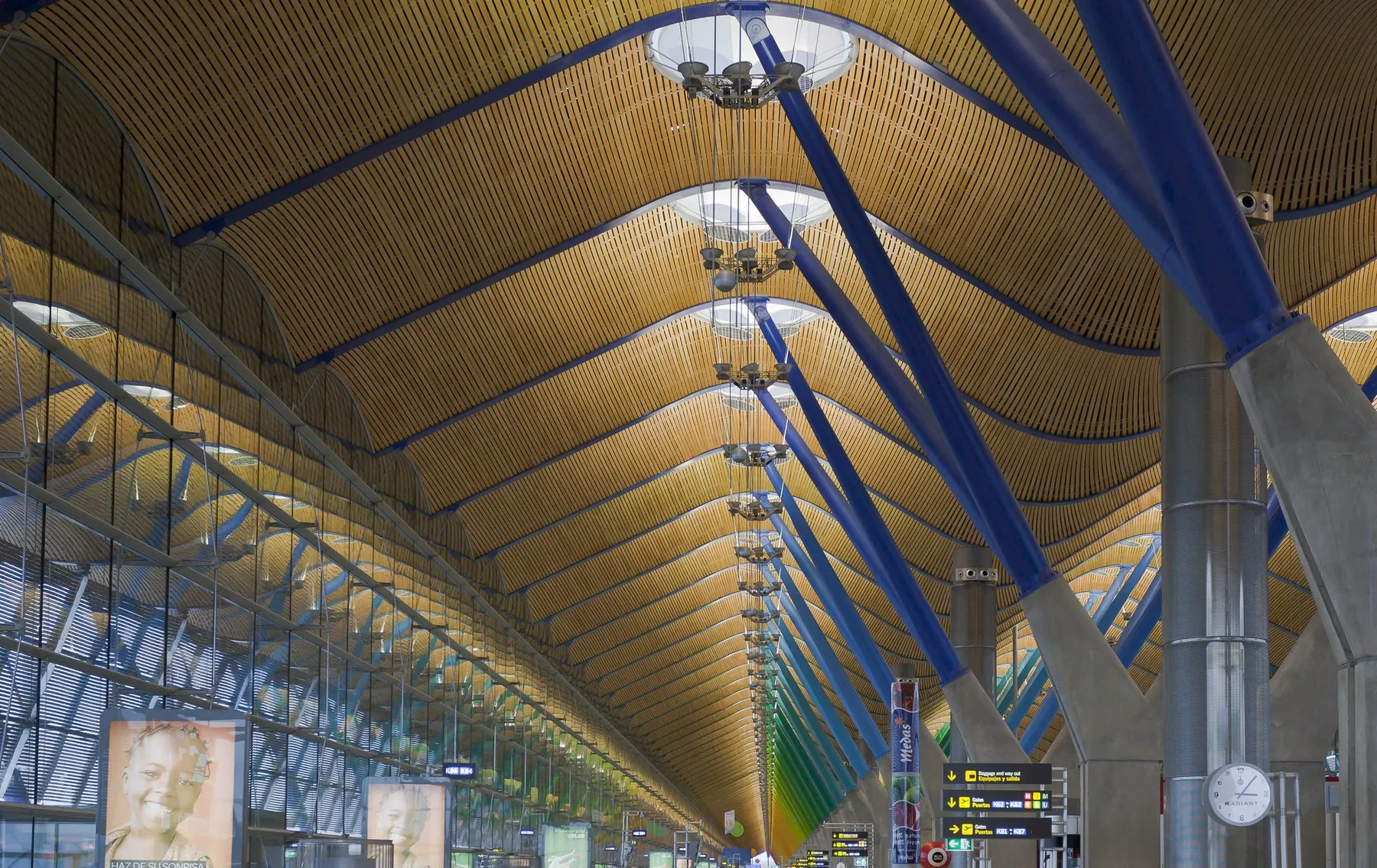
Madrid-Barajas, officially Adolfo Suárez Madrid-Barajas, is Spain's busiest airport and the main gateway for direct flights from the Gulf, the Middle East and the Americas. It lies about 12 km northeast of the city centre, and on a good day you can be at your hotel within 40 minutes of collecting your bags. On a bad day, with a long passport queue, tired children and four suitcases, the same journey can feel much longer. This guide explains the terminals, the arrival steps and every way into the city, so you can choose what suits your group.
The terminals at a glance
Barajas has four terminals in two separate areas, a few kilometres apart.
| Terminal | Main users | Notes |
|---|---|---|
| T1, T2, T3 | Most non-Iberia airlines, including many European and international carriers | Connected buildings; metro station "Aeropuerto T1-T2-T3" |
| T4 | Iberia, oneworld partners and some other airlines | Large modern terminal with its own metro and Cercanías stations |
| T4S | Satellite of T4 for many long-haul and non-Schengen flights | Linked to T4 by an automatic underground train; you exit via T4 |
A free shuttle bus links all terminals, according to the city tourism office, every few minutes during the day and less frequently at night. Always check which terminal your airline uses, especially if someone is meeting you.
Arrival step by step
- Passport control. Arriving from outside the Schengen area, you go through border control. Since April 2026, the EU's Entry/Exit System (EES) is fully operational: non-EU visitors on short stays have their passport details, facial image and fingerprints recorded on their first entry. Expect this to take a little longer on your first trip. The EU's separate ETIAS travel authorisation for visa-exempt travellers has no confirmed start date yet (the EU says it will announce it several months in advance); check the official European Commission travel portal before you fly.
- Baggage reclaim. Screens show your belt number. At T4S, you first take the internal train to T4 before reaching the baggage hall.
- Customs. Walk through the green channel if you have nothing to declare, or the red channel if you do.
- Arrivals hall. Here you will find ATMs, mobile SIM shops, car-hire desks, taxi ranks and the meeting point for pre-booked transfers.
Ways into the city
Metro (Line 8)
Line 8 runs from both airport areas (T4 and T1-T2-T3) to Nuevos Ministerios, where you can change to other lines. According to esMADRID, the ride takes under 20 minutes from T4 and about 12 minutes from T1-T2-T3. As of October 2026, an airport supplement of €3 applies on top of the standard ticket for journeys starting or ending at the airport stations, and contactless bank cards are accepted at the gates. Check current fares on the Madrid transport authority's website.
Best for: light travellers staying near a metro line. Less ideal for: large suitcases, strollers or hotels that need one or two changes, as some stations have long corridors and stairs.
Airport Express bus
The Airport Express bus runs 24 hours a day between the terminals and the city centre, stopping at O'Donnell and Cibeles and ending at Atocha during the day; at night it terminates at Cibeles. The journey takes roughly 30 to 40 minutes depending on traffic. There is a single flat fare, payable on board.
Best for: night arrivals and travellers staying near Cibeles, Atocha or the Paseo del Prado. Less ideal for: families with a lot of luggage at busy times, as there is limited space for bags.
Cercanías suburban train (C-1)
Cercanías line C-1 stops only at T4 and runs to Chamartín, Nuevos Ministerios and Atocha. Trains run roughly every 20 to 30 minutes. If you are connecting to a high-speed train, the Cercanías leg is included free with many long-distance Renfe tickets; check the conditions of your ticket.
Best for: connecting straight to a long-distance train at Atocha or Chamartín. Less ideal for: arrivals at T1, T2 or T3, who must first take the shuttle bus to T4.
Taxi
Official Madrid taxis are white with a red diagonal stripe on the front doors. Take them only from the official ranks outside each terminal. As of October 2026, a fixed fare of €33 applies between the airport and any address inside the M-30 ring road, at any hour and with no supplements for luggage or night service, according to Madrid City Council. For destinations outside the M-30, the meter applies, with an airport minimum fare. Check the current fare on the city council's website.
Most taxis are standard saloons with room for four passengers and a few suitcases. Larger groups may need two cars or a minivan, which can mean waiting at the rank.
Best for: couples and small families with moderate luggage going to central hotels. Less ideal for: groups of five or more, or families needing child seats (see below).
Ride-hailing apps
Licensed VTC services operate in Madrid through the usual apps, with pick-up in designated areas of each terminal. Prices vary with demand.
Comparison table
| Option | Time to centre (approx.) | Luggage | Night service | Child seats |
|---|---|---|---|---|
| Metro Line 8 | 12–20 min to Nuevos Ministerios, plus connections | Limited | No | Not applicable |
| Airport Express bus | 30–40 min | Limited | Yes, 24 h | Not applicable |
| Cercanías C-1 (T4 only) | About 25 min to Atocha | Moderate | No | Not applicable |
| Taxi | 20–40 min | Moderate | Yes | Not usually provided |
| Pre-booked transfer | 20–40 min | Planned for your group | Yes | On request |
Times assume normal traffic and do not include waiting.
When a pre-booked transfer makes sense
Public transport in Madrid is good, and many travellers will not need anything else. A pre-booked transfer is worth considering when:
- You are travelling as a family. A driver waiting in the arrivals hall, a vehicle sized for your group and luggage, and child seats arranged in advance take the friction out of the first hour.
- You have a lot of luggage. Several large suitcases, a stroller and hand luggage rarely fit comfortably in a standard taxi or on the metro.
- You land late at night or very early. After a long-haul flight, knowing someone is waiting with your name removes the need to navigate ranks or night buses.
- Your hotel is outside the M-30 or outside Madrid. The fixed taxi fare no longer applies, and longer journeys benefit from a planned vehicle.
- You are continuing straight to another city. Some travellers go directly from Barajas to Toledo, Segovia or a hotel in the countryside.
A note on child seats
Spanish traffic rules, as set out by the DGT (Spain's traffic authority), require children up to 135 cm tall to travel in an approved child restraint suited to their size and weight, generally in the rear seats. Taxis are not obliged to carry child seats. If you are travelling with young children, arrange seats in advance or bring your own. Our family travel guide explains the rules in more detail.
Our airport transfer service
We arrange airport transfers at Madrid-Barajas on request: a driver meets you in the arrivals hall, the vehicle is matched to your group and luggage, and child seats can be requested in advance. Availability and price are confirmed by the team after reviewing your flight details. If you would like a driver for more than the arrival, a car with driver can cover your days in the city or a Madrid day at your own pace. For what to do once you arrive, see our Madrid destination guide, and send your flight details through the trip planner.
Questions readers ask
How much is a taxi from Madrid airport to the city centre?
Which terminal will I arrive at?
What is the fastest way from the airport to the centre?
Is there public transport at night?
Sources
- Aena — Adolfo Suárez Madrid-Barajas Airport
- esMADRID (Madrid City Council tourism) — Arriving by plane
- Consorcio Regional de Transportes de Madrid — fares and lines
- Renfe Cercanías Madrid
- Madrid City Council — taxi fares
- DGT (Dirección General de Tráfico) — Travelling with children
- European Commission — Entry/Exit System (EES) and ETIAS
Opening times, ticket rules and fares change. Always confirm on the official site before you travel.


