Day Trips from Madrid: Toledo, Segovia, Ávila, El Escorial and Aranjuez
Five historic towns within about an hour of Madrid, compared side by side, with travel times, highlights and tips on choosing and combining them.
One of Madrid's great advantages is what lies around it. Within roughly an hour of the capital are five towns that are each listed by UNESCO, from the medieval walls of Ávila to the royal gardens of Aranjuez. Each makes a rewarding day out, but they are very different in character, distance and pace. This guide compares them side by side so you can choose the right one, or the right pair, for your trip.
The five at a glance
| Destination | Distance by road | Drive time (approx.) | Train (approx.) | Best known for | Ideal for |
|---|---|---|---|---|---|
| Toledo | About 75 km | About 1 h | About 33 min by high-speed train from Atocha | Three cultures, cathedral, El Greco | First-time visitors, history lovers |
| Segovia | About 90 km | About 1 h 15 | About 30 min by high-speed train from Chamartín to Segovia-Guiomar | Roman aqueduct, Alcázar | Families, photographers |
| Ávila | About 110 km | About 1 h 20 | About 1 h 20–1 h 50 by regional train | Medieval walls, Saint Teresa | Combining with Segovia |
| El Escorial | About 55 km | About 50 min | About 1 h by Cercanías suburban train | Philip II's monastery-palace | Art and royal history |
| Aranjuez | About 50 km | About 45 min | About 45 min by Cercanías from Atocha | Royal palace and gardens | Relaxed pace, gardens |
Times are indicative for normal traffic and direct services; check current timetables on the Renfe website before you travel.
Toledo: the city of three cultures
Set on a rocky hill wrapped by a loop of the River Tagus, Toledo was the Visigothic capital, a major city of Al-Andalus, and later the seat of the Castilian court. Its streets hold a Gothic cathedral among the finest in Spain, the small mosque of Cristo de la Luz built in 999, the synagogues of Santa María la Blanca and El Tránsito, and El Greco's masterpiece, The Burial of the Count of Orgaz, in the church of Santo Tomé.
Don't miss: the Mirador del Valle on the road across the river for the classic panorama; a walk through the old Jewish quarter; marzipan, Toledo's sweet speciality.
Practical: the old town is steep, with narrow streets closed to most traffic. Public escalators help on the way up. The high-speed station is outside the centre, so allow a short taxi or bus ride.
Our private Toledo day trip includes hotel pick-up and the viewpoint.
Segovia: aqueduct, cathedral and castle
Segovia's Roman aqueduct, built around the late first or early second century AD, crosses the Plaza del Azoguejo in a line of granite arches held together without mortar, at its highest about 28 metres. From there, a walk through the old town leads to the late Gothic cathedral and on to the Alcázar, a castle on a rocky spur whose silhouette is often said to have inspired fairy-tale castles.
Don't miss: the view of the Alcázar from below, near the Fuencisla area; roast suckling lamb or cochinillo in a traditional restaurant (note that cochinillo is pork; roast lamb, cordero asado, is the other classic).
Practical: the high-speed station (Segovia-Guiomar) is outside the town; buses link it to the aqueduct. In winter Segovia is often several degrees colder than Madrid.
Ávila: some of Europe's best-preserved medieval walls
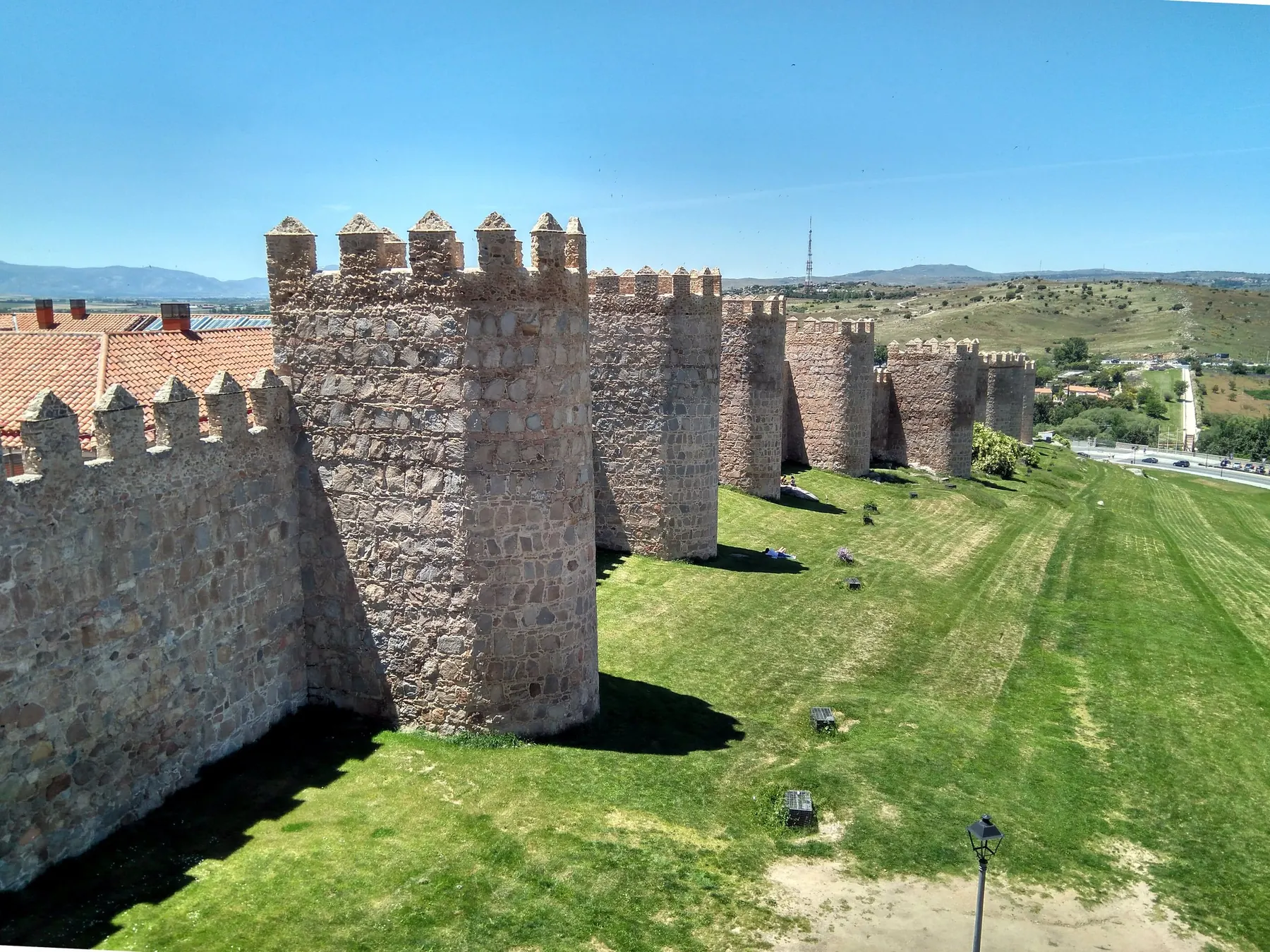
Ávila's Romanesque walls, built mainly in the eleventh and twelfth centuries, run for around two and a half kilometres with dozens of towers and nine gates, enclosing the whole old town. Part of the wall walk is open to visitors. Ávila is also the city of Saint Teresa, the sixteenth-century mystic, and has fine Romanesque churches outside the walls.
Don't miss: the Cuatro Postes viewpoint just outside the town, for the full view of the walls; yemas, small sweets made with egg yolk.
Practical: Ávila is the furthest of the five and best combined with Segovia in a single day by car. See our private Segovia and Ávila day.
El Escorial: Philip II's monastery-palace
The Royal Monastery of San Lorenzo de El Escorial, built between 1563 and 1584 for King Philip II, is at once a monastery, a palace, a basilica, a library and the burial place of Spanish kings. Its austere granite architecture contrasts with the treasures inside: the frescoed library, paintings by Titian and El Greco, and the Pantheon of the Kings.
Don't miss: the library hall; the town of San Lorenzo de El Escorial around the monastery, with mountain views.
Practical: the monastery is run by Patrimonio Nacional and closes on some days; check before going. El Escorial combines well with Segovia across the Guadarrama mountains.
Aranjuez: palaces and gardens by the river
Aranjuez was the spring residence of the Spanish court. Its Royal Palace, the Jardín del Príncipe along the River Tagus, the Casa del Labrador and its avenues of trees form a cultural landscape listed by UNESCO in 2001. The atmosphere is calm and green, and Aranjuez is known for strawberries and asparagus from its market gardens.
Don't miss: a slow walk or a ride through the gardens; a seasonal heritage "Strawberry Train" has traditionally run from Madrid on some spring and autumn weekends (check whether it operates during your dates).
Practical: an easy half day. It pairs well with the village of Chinchón, known for its arcaded main square.
How to choose
- Only one day to spare? Toledo, for its depth and variety.
- Travelling with children? Segovia: the aqueduct and castle capture young imaginations, and distances are short.
- Love art and royal history? El Escorial, possibly combined with Segovia.
- Want to see two towns? Segovia and Ávila, or El Escorial and Segovia, by car.
- Prefer a relaxed day? Aranjuez, with gardens and a long lunch.
- Hot summer day? Segovia and Ávila are higher and slightly cooler than Madrid; Toledo can be as hot as the capital.
Two sample days
A full day in Toledo
- 9:00 Leave Madrid; arrive around 10:00 at the Mirador del Valle for the panorama.
- 10:30 Cathedral, then the El Greco painting at Santo Tomé.
- 13:30 Lunch in the old town.
- 15:00 The synagogues and the Cristo de la Luz mosque, walking through the old Jewish quarter.
- 17:30 Marzipan stop and return to Madrid by about 19:00.
Segovia and Ávila in one day
- 8:45 Leave Madrid through the Guadarrama mountains.
- 10:00 Segovia: the aqueduct, the old town and the Alcázar.
- 13:30 Lunch in Segovia.
- 15:30 Drive to Ávila (about an hour); the Cuatro Postes viewpoint and a walk on the walls.
- 18:00 Return to Madrid, arriving around 19:30.
Eating on a day trip
Lunch is a highlight of any day out, but local specialities are worth understanding. Segovia's famous cochinillo is suckling pig; roast lamb, Castilian soups and grilled meats or fish are good alternatives. In Toledo, game dishes such as partridge are traditional, and marzipan is made from almonds and sugar. If you have dietary requirements, ask before ordering; our guide to Muslim-friendly Spain has useful phrases.
Staying overnight instead
Toledo and Segovia change character in the evening, once day visitors leave. If your schedule allows, a night in either town lets you see floodlit monuments and quiet streets, and makes the following morning's visits unhurried.
Train, tour bus or car with driver?
- Train: fast and inexpensive for Toledo and Segovia, but stations are outside the centres and combining two towns is impractical.
- Group tour: convenient, but with fixed times and limited flexibility for families.
- Car with driver: door-to-door from your hotel, flexible timing, the option to combine two towns and stop at viewpoints, and space for strollers and shopping.
We arrange private day trips and a car with driver on request, including the Toledo day trip and the Segovia and Ávila day. For more about the capital itself, see our Madrid guide, and share your dates through the trip planner.
Questions readers ask
Which is the best day trip from Madrid?
Can I visit Segovia and Ávila in one day?
Is it better to go by train or by car?
How long should I spend in Toledo?
Sources
- Renfe — official timetables and tickets
- esMADRID — Getting around Madrid by Cercanías train
- UNESCO — Historic City of Toledo
- UNESCO — Old Town of Segovia and its Aqueduct
- UNESCO — Old Town of Ávila with its Extra-Muros Churches
- UNESCO — Monastery and Site of the Escurial, Madrid
- UNESCO — Aranjuez Cultural Landscape
- Patrimonio Nacional — Royal Sites (El Escorial, Aranjuez)
Opening times, ticket rules and fares change. Always confirm on the official site before you travel.


