Granada: The Alhambra and the Albaicín
A full day shaped around your Nasrid Palaces slot: the Alhambra at an unhurried pace, then the Albaicín's lanes and viewpoints as the palace walls turn gold.
Price on requestWe send a written quote
Seville, Granada and Córdoba: the living legacy of Al-Andalus
Andalusia is southern Spain at its most evocative: the Alhambra, the Mosque-Cathedral of Córdoba and Seville's Alcázar, set among orange-scented squares, white villages and a warm, unhurried way of life.
For nearly eight centuries, from 711 to 1492, much of the Iberian Peninsula was Al-Andalus, a land of Muslim rule where scholars, poets, architects and farmers shaped a civilisation whose traces are still everywhere in southern Spain. Today Andalusia is Spain's most populous region, with eight provinces stretching from the Atlantic to the Mediterranean. For many Arab visitors it is the emotional heart of a trip to Spain: a place where Arabic inscriptions still run along palace walls and where the word for a water wheel, a village or an olive comes from the same language you speak at home.
Andalusia is warm in every sense. Streets fill after sunset, families gather on plazas until late, and conversation flows easily. Life follows the sun: in summer the hottest hours are for shade and rest, while evenings are for walking. It is also deeply devotional and festive, with Holy Week processions, spring fairs and local pilgrimages marking the calendar.
The region is large: Seville to Granada is around 250 km by road, roughly three hours' drive. Plan a route rather than trying to see everything.
The regional capital and the most theatrical of Andalusia's cities. Its Santa Cruz quarter, the old Jewish neighbourhood, is a tangle of whitewashed lanes and patios beside the Alcázar. Triana, across the Guadalquivir, is the traditional quarter of potters, sailors and flamenco. The Plaza de España, built for the 1929 Ibero-American Exposition, and the María Luisa Park beside it are lovely in the late afternoon.
Once the capital of the Umayyad Caliphate of Al-Andalus and among the largest cities of tenth-century Europe. Its Mosque-Cathedral and the lanes of the Judería form a UNESCO World Heritage historic centre. In May, the city's famous patios fill with flowers during the Patios Festival, itself recognised by UNESCO as intangible heritage.
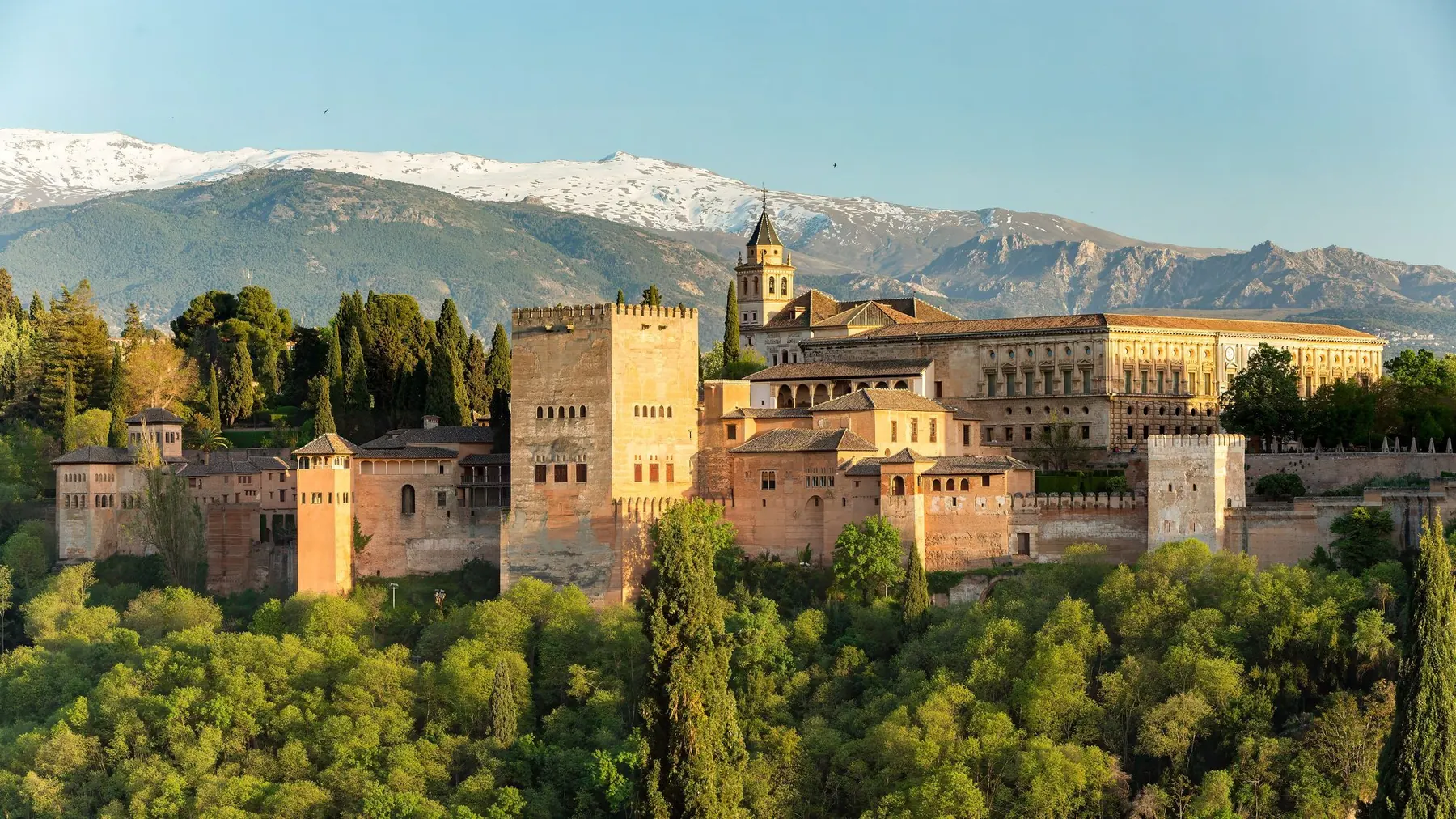
Set beneath the Sierra Nevada, Granada was the last capital of Al-Andalus under the Nasrid dynasty until 1492. Above the city rises the Alhambra; facing it, across the Darro valley, is the Albaicín, the old Muslim quarter of steep lanes, walled gardens (cármenes) and viewpoints. Granada also has a lively student life and a long tradition of free tapas served with drinks.
Málaga is the region's main airport city and a cultured port; nearby lie Marbella and the Costa del Sol (see our Málaga and Marbella guide). Ronda, perched over a deep gorge, and the white villages of the mountains make a superb day trip.
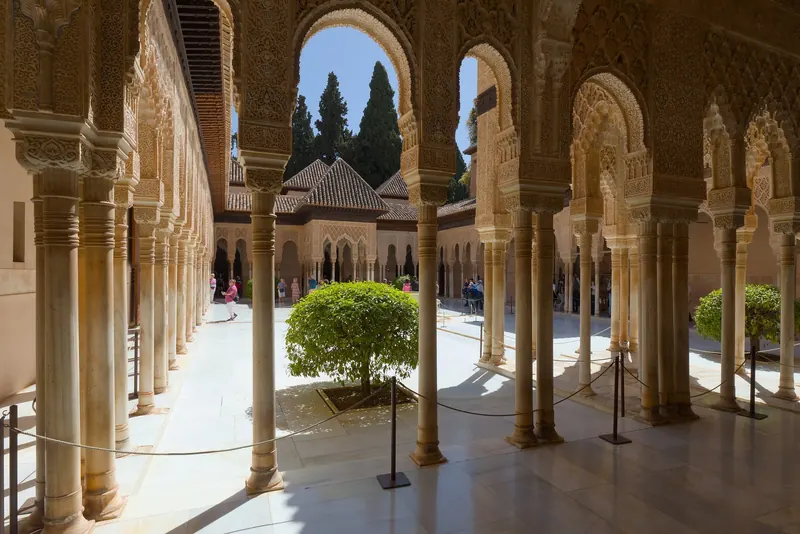
The Alhambra is a palatine city of the Nasrid sultans, built mainly in the thirteenth and fourteenth centuries. The Nasrid Palaces, with the Court of the Myrtles and the Court of the Lions, are among the finest examples of Islamic art anywhere; the Generalife gardens show the Andalusi love of water and shade. Entry to the Nasrid Palaces is by a fixed time slot printed on your ticket, and tickets sell out, so read our Alhambra guide before you go.
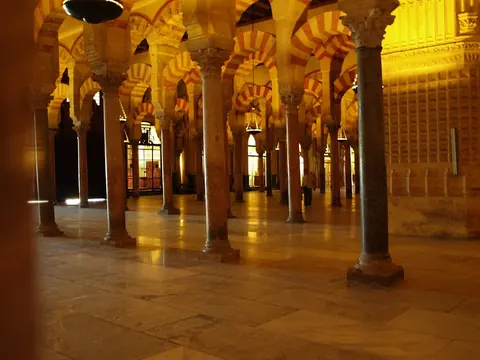
The Mosque-Cathedral of Córdoba was begun in 785 under Abd al-Rahman I and enlarged over two centuries, most splendidly under al-Hakam II, whose mihrab is a masterpiece of Umayyad mosaic. A cathedral was built within it in the sixteenth century. Its forest of double arches, striped in red brick and white stone, is one of the most moving interiors in Europe.
Medina Azahara, outside Córdoba, was the palatial city founded by the caliph Abd al-Rahman III in the tenth century. Destroyed within decades, it was excavated in modern times and is now a UNESCO site with an excellent museum.
The Real Alcázar of Seville is a royal palace still in use, whose Mudéjar halls were built for the Castilian king Pedro I in the fourteenth century by craftsmen trained in Andalusi traditions. Its gardens are a world of their own.
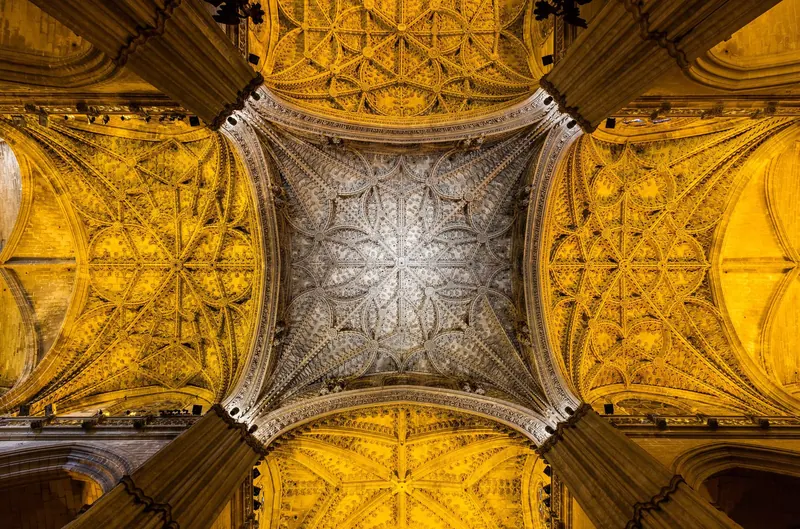
Seville Cathedral and the Giralda stand on the site of the city's great Almohad mosque; the Giralda began as its minaret in the twelfth century and was later topped with a Renaissance belfry.
For the full story, follow our Al-Andalus heritage trail.
Andalusian food is made for heat and sociability. In summer, chilled soups such as gazpacho and the thicker salmorejo from Córdoba are everywhere. Fried fish (pescaíto frito) is a coastal tradition, and Andalusia produces much of the world's olive oil. Tapas culture is strongest here; in Granada and some other cities, a small tapa often arrives free with each drink.
The Andalusi legacy appears in almonds, honey, cumin, saffron and citrus, and in pastries such as pestiños. Many tapas contain cured ham or other pork products, so ask clearly; our guide to Muslim-friendly Spain explains how to check halal certification. Granada and Córdoba both have active Muslim communities.
Children enjoy the Alcázar gardens, horse carriages around Seville's Plaza de España, boat rides on the Guadalquivir, the Isla Mágica theme park in Seville and the beaches of the Costa del Sol. The biggest challenge is heat: from June to September, schedule monuments early, rest at midday, and go out again in the evening, as local families do. Streets in the Albaicín and Santa Cruz are steep or cobbled, so a light stroller or a baby carrier is easier than a large pram. See our family guide to Spain.
The most common pattern is to arrive in Madrid and take the high-speed train south, or to fly into Málaga and finish in Madrid. Córdoba is the natural hinge: about 45 minutes by fast train from Seville and around an hour and a half from Granada. Valencia and Barcelona are better reached by domestic flight than by road.
High-speed and regional trains connect Seville, Córdoba, Málaga and Granada, but stations are often outside the old centres, and luggage makes connections tiring. Driving yourself is pleasant on open roads but difficult in historic quarters with restricted access and narrow streets.
A car with driver gives you door-to-door transfers between cities, flexible stops at places like Medina Azahara or a hilltop village, and help with timing around ticketed visits. We arrange private visits such as Granada: Alhambra and Albaicín, Córdoba: Mosque-Cathedral and Jewish Quarter and Seville: Alcázar and Santa Cruz, as well as complete custom programmes. All are arranged on request; share your dates through the trip planner.
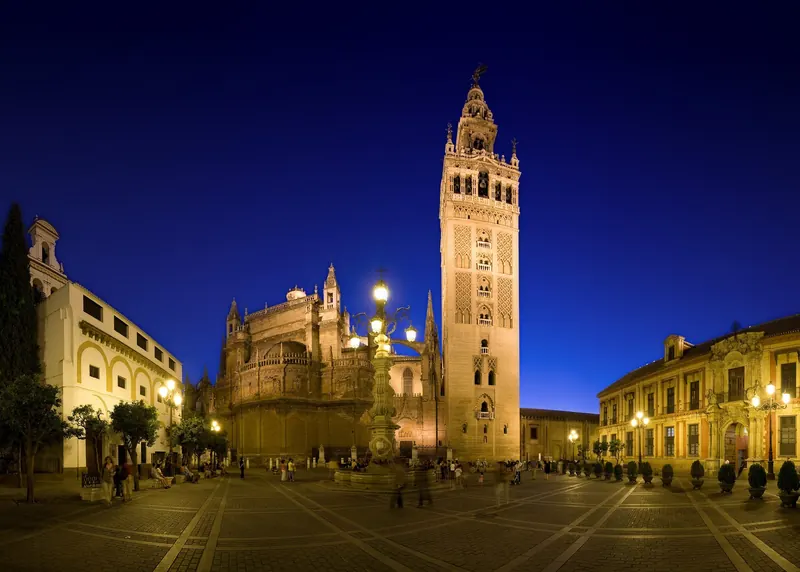

A full day shaped around your Nasrid Palaces slot: the Alhambra at an unhurried pace, then the Albaicín's lanes and viewpoints as the palace walls turn gold.
Price on requestWe send a written quote
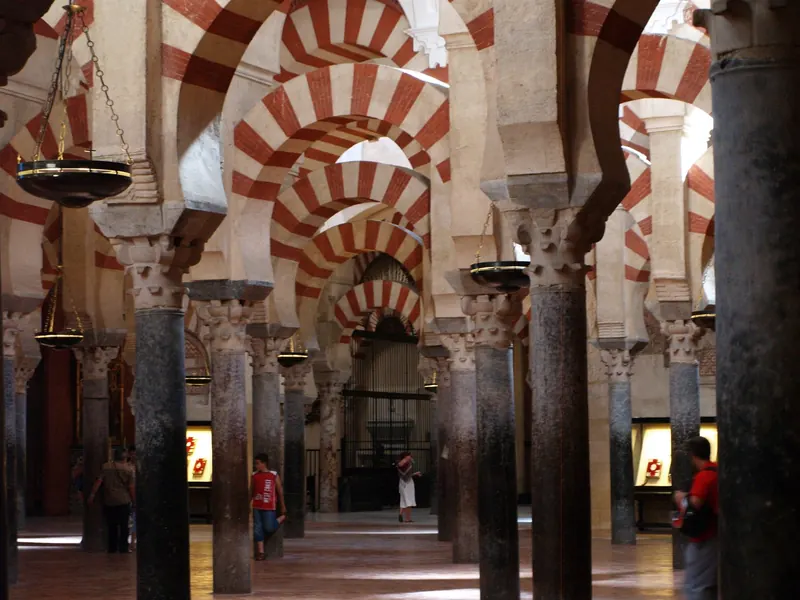
A calm half day in the former capital of the Caliphate: the Mosque-Cathedral's forest of arches, the flower-filled lanes of the Judería and sunset over the Roman bridge.
Price on requestWe send a written quote
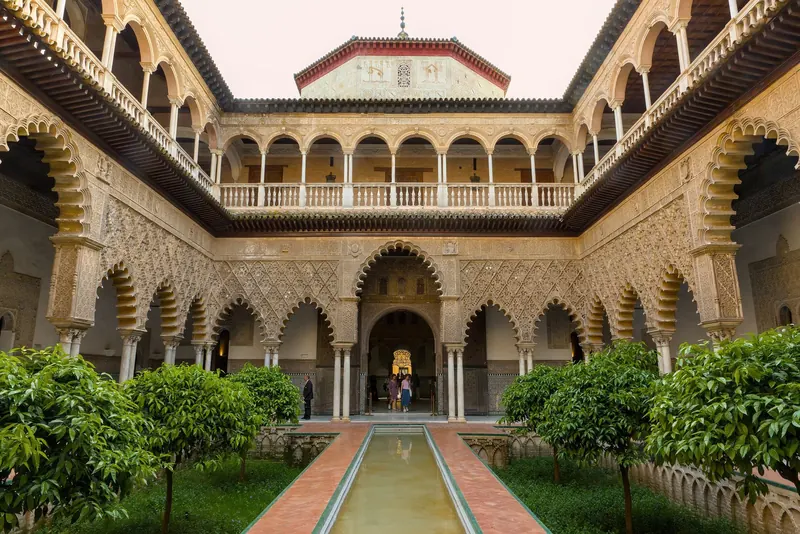
Seville's royal palace and gardens in the cool of the morning, the lanes of Santa Cruz, the Giralda and an evening by the river, with a driver for the longer hops.
Price on requestWe send a written quote
Save the ones you like to My Trip — we can build your programme around them.
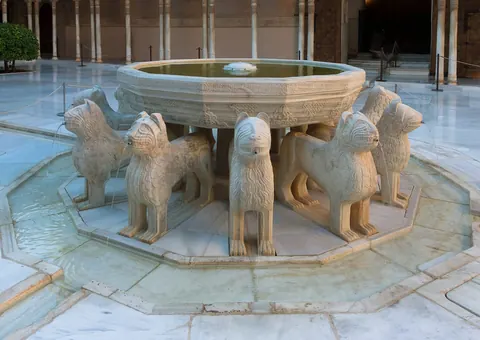
Landmark
The Nasrid palace-city above Granada: the Court of the Lions, the Hall of the Ambassadors and the Generalife gardens. Spain's most visited monument — and the one that most needs planning.
Tip: Entry to the Nasrid Palaces is at the time printed on your ticket; it cannot be changed at the door.
Official website ↗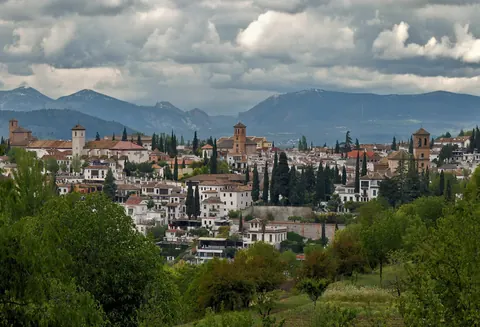
Neighbourhood
Granada's old Moorish quarter on the hill facing the Alhambra, with whitewashed lanes and walled garden houses (cármenes).
Tip: Climb to the San Nicolás viewpoint before sunset to see the Alhambra against the Sierra Nevada.
Landmark
The forest of red-and-white arches begun by Abd al-Rahman I in the 8th century, with a cathedral built in its centre.
Tip: Allow at least an hour and a half, then walk the old Jewish quarter next door.
Official website ↗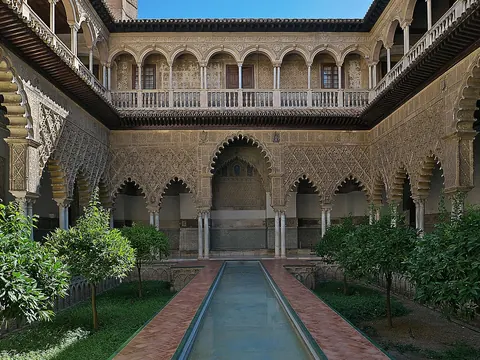
Landmark
A royal palace still in use, with ornate Mudéjar courtyards and wide gardens of orange trees and fountains.
Tip: Entry is timed — book on the official website and avoid midday in summer.
Official website ↗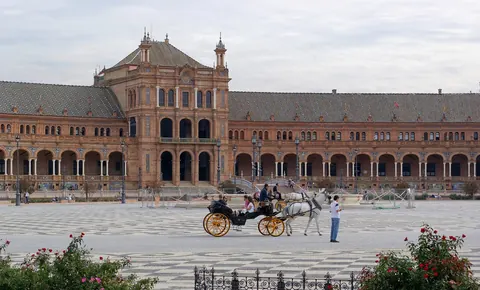
Landmark
A brick-and-tile half-circle built for the 1929 exhibition, lined with azulejo benches for each Spanish province and a small canal with rowing boats.
Tip: Ask the children to find the bench of every city you will visit.
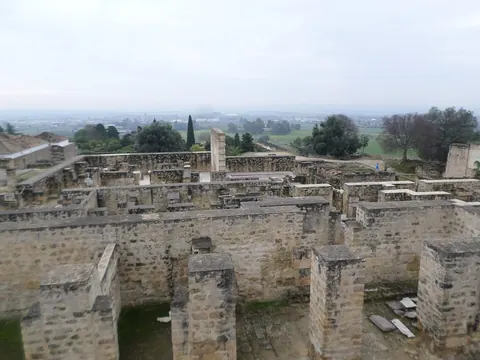
Landmark
The ruins of the caliphal city built by Abd al-Rahman III west of Córdoba in the 10th century, a UNESCO World Heritage Site.
Tip: You need a car or the site's shuttle bus from Córdoba.
Official website ↗
Heritage · 9 min read
A respectful, accurate journey through the great monuments of Al-Andalus, what each one tells us, and how to link them into a single trip.

Heritage · 8 min read
Everything that matters for a calm Alhambra visit: how the official tickets and Nasrid Palaces slots work, the best route through the site and where to see it from afterwards.
Planning · 8 min read
A calm, realistic week through the three great cities of Al-Andalus, with travel times, booking advice and room to breathe.